Re-Editions: Between Zeitgeist and Timelessness
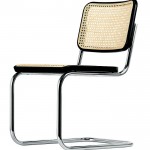
...Take Jil Sander, for example, who teamed up with Thonet to give Marcel Breuer's famous cantilever chair an elegant new look – celebrated above all in Milan...
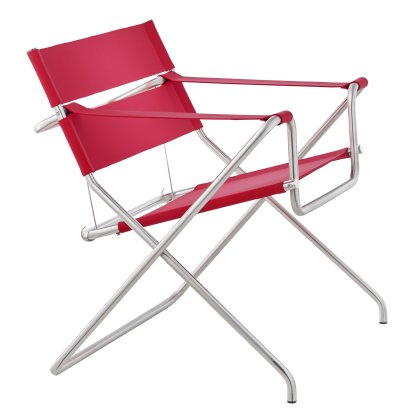
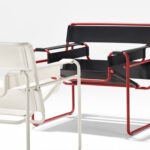
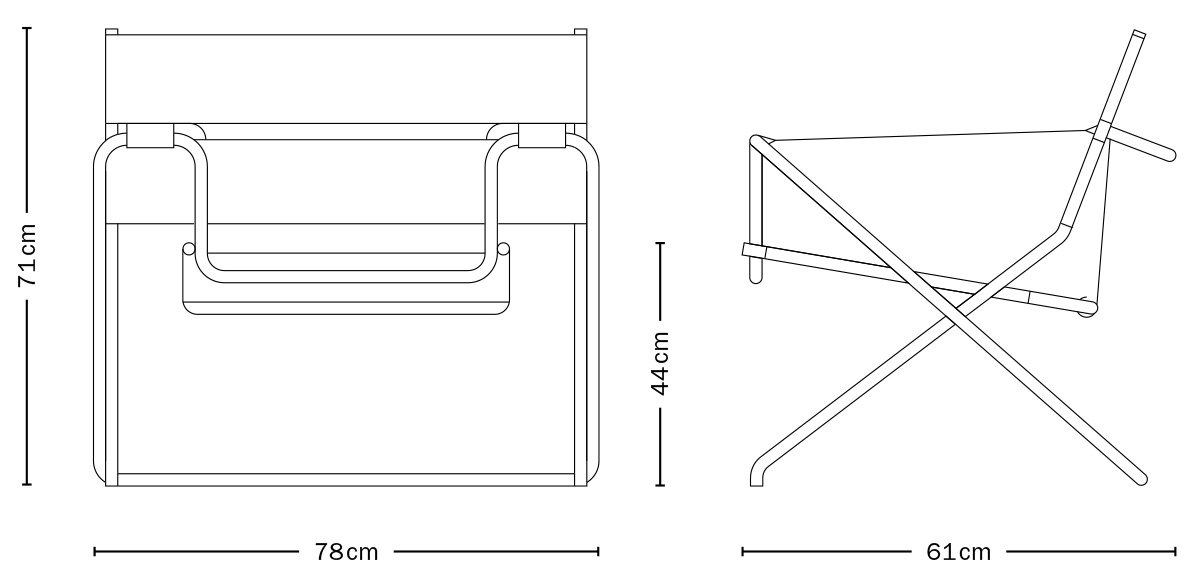
| Product type | Collapsible armchair. |
| Dimensions | Width: 78 cm Depth: 61 cm Height: 71 cm Seat height: 38 cm The seat height can vary due to production conditions, the dimensional stability of the material and the hook-in height of the seat surface. |
| Colours | Iron thread![]() Bauhaus Straps ![]() ![]() ![]() |
| Material | Frame: steel tubing , chrome plated Seat and back: Belts, available in Bauhaus fabric (100 % polyacrylic) or iron thread |
| Function & properties | Foldable and thus space-saving storage |
| 360 Video | |
| Certification | ![]() The re-editions of Bauhaus models produced by Tecta are approved by the Bauhaus Archive in Berlin and bear the Bauhaus signet designed by Oskar Schlemmer. |
| Care | To clean the frame, we recommend a soft, damp cloth The fabric covers can be carefully vacuumed Please treat leather surfaces regularly with a suitable leather care product |
| Awards & museum | Since 1980 part of the Permanent Collection of Museum of Modern Art (MoMA), New York |
| Warranty | 24 months |
| Product presentation |
...Take Jil Sander, for example, who teamed up with Thonet to give Marcel Breuer's famous cantilever chair an elegant new look – celebrated above all in Milan...
...Kukkapuro developing an ice hockey stick chair that is a very nice twist on the, in all probability apocryphal, story of Marcel Breuer being inspired by bicycle handle bars to employ steel tubing in furniture; an ice hockey stick chair that introduces, and very efficiently elucidates, various formal, aesthetic and constructional aspects that are of such importance in the Yrjö Kukkapuro oeuvre... Plexiglass which also features, alongside tubular steel, in a 1969 cantilever chair which takes up Marcel Breuer's vision of us one day sitting on a "resilient column of air"2, and not only allows one to approach that day via, as Breuer did, the inherent elasticity of the cantilever, but also to approach that day via the transparent seat shell, a conceit which means you are almost literally floating on air...
...Wandering aimlessly through the digital Marcel Breuer Archive one afternoon, we stumbled across a letter dated July 25th 1950 from Peter M Fraser, one of Breuer's employees, to the Eames Office, enquiring about a lighting design by Charles and Ray that Breuer was interested in using in one of his architectural projects, and requesting... And brings us back to Marcel Breuer...
...Prior to his aforementioned acquaintance with Mies van der Rohe's cantilever chairs, Lorenz had seen works by Marcel Breuer in the office of Breuer's associate, business partner, and fellow Hungarian, Kálmán Lengyel, and subsequently not only joined the board of Breuer and Lengyel's Standard Möbel company but undertook experiments in his own workshop to further develop the technical, material, aspects of Breuer's work, experiments which, as he describes, were intended to bring the same resilience to Breuer's designs that he had felt in Mies's... Thonet, serving between 1933 and 1935 as, and somewhat logically, Head of Industrial Property Rights, before spending the second half of the 1930s in closed contact with the likes of Mies van der Rohe, Hans Luckhardt, Heinz Rasch, Lily Reich, László Moholy-Nagy and Marcel Breuer...
...The story begins in Dessau in the mid 1920s and the development of tubular steel furniture, a process in which Marcel Breuer unquestionably played a major, if not the major, role... Aware of the commercial possibilities of the genre Marcel Breuer established in late 1926/early 1927 the company Standard-Möbel in Berlin with fellow Magyar Kálmán Lengyel, the first dedicated manufacturer of tubular steel furniture...
..."Herr Mies van der Rohe proposed to close Bauhaus... 1 With this sober protocol dated July 20th 1933, but referring to a meeting held on July 19th 1933, the closing of Bauhaus Berlin, and so the end of the Bauhaus story, is formally confirmed...
...Herewith we inform the directors of the Hochschule für bildende Kunst that the Provisional Republican Government has approved the request to rename the unified Hochschule für bildende Kunst and Kunstgewerbeschule as "Staatliches Bauhaus in Weimar"1 With this succinct letter from the Office of the Hofmarschallamt in Weimar on 12th April 1919, Bauhaus formally existed... 4 On April 1st 1919 Gropius formally signed a contract with the Office of the Hofmarschallamt in Weimar appointing him Director of the new unified institution, an institution which received its new name on April 12th, and shortly afterwards Walter Gropius published his "Bauhaus Manifesto"...
All 'Marcel Breuer', 'Bauhaus' Posts